By Mayank Bhardwaj · August 20, 2026 · 2 min read
How to plan a year in 52 weeks (without a productivity system)
No app stack, no methodology, no streaks. A year plan that fits on one line a week and survives real life — plus the math of why 52 is enough.
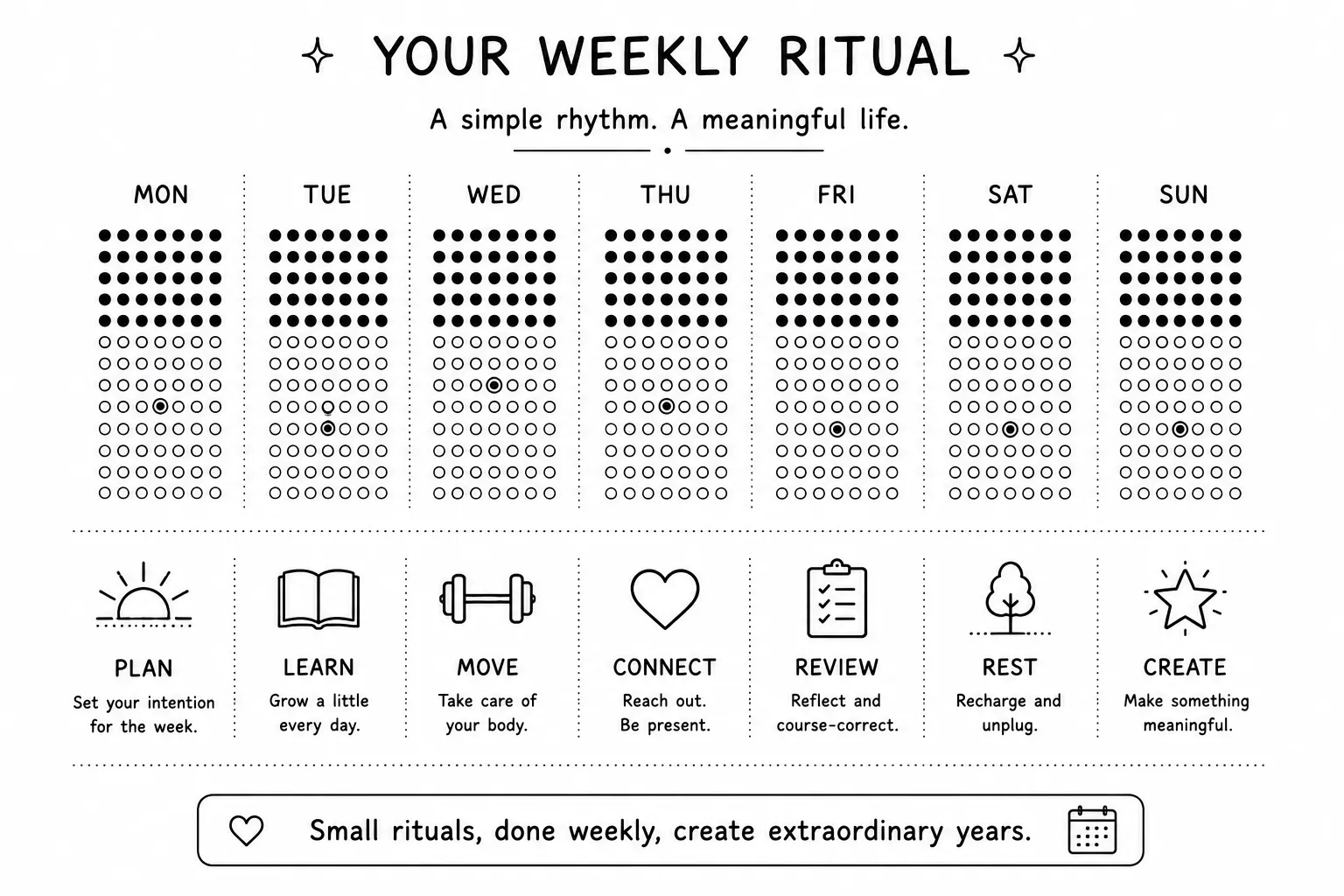
Here is a complete yearly planning system: look at the 52 weeks, write one line for the week you’re in, repeat. That’s the whole thing. This post is just the reasoning — and the small amount of math that makes it work.
Why the year fails as a planning unit
January resolutions fail for a boring reason: a year is 365 days of undated intention. “Get fit in 2026” has no address — no week where it lives, no moment it becomes false. By March it is neither succeeded nor failed, just ambient, and ambient goals don’t survive contact with the actual countdown.
The 52-slot reframe
Now do the arithmetic the resolution skips. A year is 52 weeks and a day. Subtract holidays, illness, the weeks eaten by travel and life admin — call it 40 working weeks. If a real project needs ten good weeks, your year holds four such projects. Four. Not the nine on your someday list.
That number does more work than any productivity method: it forces the Burkeman question (choose almost nothing) at the scale where choosing is still possible. Pick the four. Give each a season. You’ve now planned the year better than most strategy documents.
The one-line week
Each Monday, one intention, phrased so Sunday can judge it: “draft the landing page,” not “work on business.” Write it where you cannot avoid it — a card on the desk, or (our obvious preference) written on the wallpaper itself, where it sits above seven honest dots until the week expires it.
Sunday: the intention either happened or it didn’t. No streaks, no scores, no backlog grooming. A missed week costs one dot out of 52 — visible, priced, survivable — and the next Monday is already loading.
Why the dots matter
Every system fails when the feedback loop lives inside an app you stop opening. The whole trick here is that the loop lives on your screen’s background: what week it is, how many are left, and one line about what this one is for. Plans don’t need more structure than that. They need more visibility than that — and visibility, it turns out, is a solved problem: it’s called a wallpaper.
Free in the browser — or living on your Mac desktop, updated nightly.