By Mayank Bhardwaj · August 20, 2026 · 2 min read
Your Life in Weeks: the complete guide to Tim Urban's idea
The 2014 Wait But Why essay that turned a lifespan into ~4,000 boxes — where it came from, why it works on the brain, and every way to live with one.
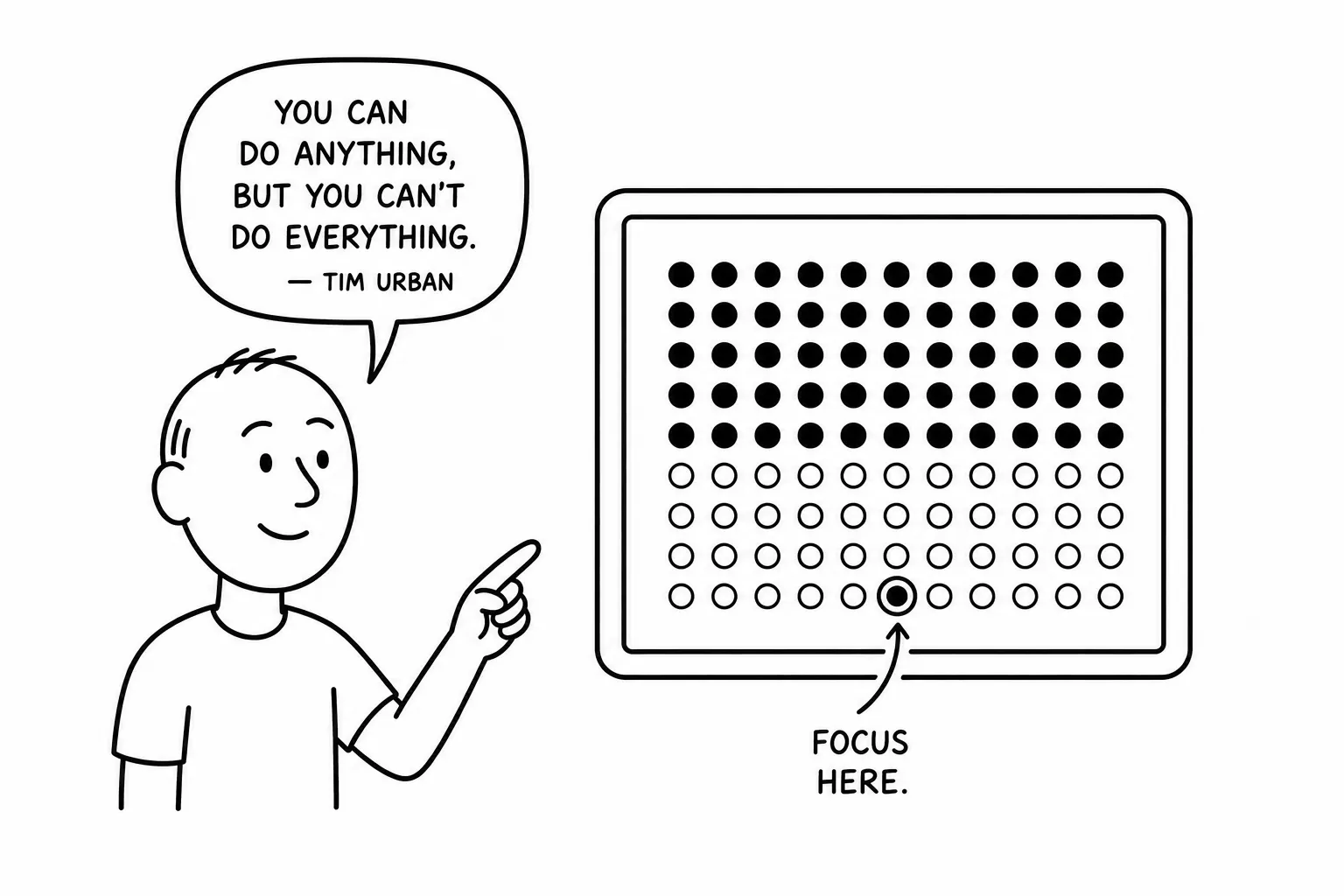
In 2014, Tim Urban published a post on Wait But Why called “Your Life in Weeks.” It contained a chart so simple it felt like a prank: a grid of little boxes, 52 across, 90 down. One box per week. An entire human life on one page.
The internet has not stopped drawing it since.
Why the chart works
The trick is a unit conversion your intuition can’t defend against. “Ninety years” is an abstraction — nobody can feel a year, let alone ninety. But a week? You know exactly what a week is. You had one last week. It went fast.
Multiply that felt sense by the roughly 4,700 weeks in a 90-year life (about 4,175 in an 80-year one — see how many weeks in a lifetime) and something uncomfortable happens: the number is small enough to picture. Small enough to count. As Urban put it, sometimes life seems short and sometimes long — but the grid doesn’t care how it seems. It just shows you.
The second trick is spatial: filled boxes versus empty ones. Your past is ink; your future is outline. You are, visibly, a dot somewhere in the middle — and the essay’s real subject was never death, but attention: most people spend most weeks on autopilot, and the grid makes autopilot visible.
What people do with it
Print it. Urban’s site sold posters; a cottage industry followed (4K Weeks being the most famous). You fill in a box each week by hand — a genuinely good Sunday ritual, if you keep it up. Our calculator prints a free one.
Chart it. Spreadsheet templates, Notion templates, hand-drawn journals. Flexible, and abandoned at roughly the rate of gym memberships.
Live with it. The version we obviously believe in: the grid as your desktop wallpaper, updating itself — one new filled dot every Monday, no ritual required. The chart’s power comes from seeing it often; a poster in the hallway gets one glance a day, but a wallpaper gets eighty.
The criticisms, fairly
Some find it morbid; Urban’s counter is that the weeks pass whether or not you count them — the grid only changes whether you notice. Others point out the horizon is fiction: you don’t get exactly 90 years. True, and it misses the point. The grid isn’t a prediction. It’s a denominator. Any honest denominator — 70, 80, 90, 100 years — does the job, which is to make this week feel like what it is: one of a limited edition.
Free in the browser — or living on your Mac desktop, updated nightly.